What is Play?
Understanding one of the most powerful ways children learn
Few ideas in education are as widely accepted or as widely misunderstood as play.
Long before children encounter classrooms, curricula or assessment, they are learning through play. It is one of humanity's oldest ways of exploring, adapting and making sense of the world. Education did not invent play; it inherited it.
Ask a group of educators what play is and you'll hear a range of answers. Some will describe it as free choice. Others will talk about enjoyment or imagination. Some will define it as child-led activity, while others see it primarily as a way of teaching curriculum content. None of these perspectives are entirely wrong, but none of them captures the whole picture either. These differences are more than matters of language. They influence the environments we create, the decisions we make as teachers and, ultimately, the opportunities children have to learn.
If we understand play as little more than a break from learning, it is easy to see why it disappears when curriculum pressures increase. If we see it as a reward for finishing "real work", it becomes something that is earned rather than valued in its own right. But if we understand play as one of the primary ways children investigate ideas, solve problems, negotiate relationships and make meaning of their world, then play is no longer separate from learning; it becomes one of the ways learning happens.
The challenge is that play refuses to fit neatly into a single definition. Researchers have spent decades trying to define it, yet no universally accepted definition exists. Rather than asking, "What is play?" it may be more helpful to ask, "What are the characteristics of experiences that feel genuinely playful?" That shift moves us away from labels and towards the conditions that enable children to think deeply, explore confidently and learn meaningfully.
Looking for the characteristics of play
Although researchers describe play in different ways, there is remarkable agreement about the qualities that make an experience genuinely playful. Rather than searching for one perfect definition, many researchers now describe play through a collection of shared characteristics. In other words, play is recognised less by what children are doing and more by how they are experiencing it.
This shift in thinking is important. It moves us away from trying to categorise activities as either "play" or "not play" and encourages us to look more closely at the conditions that support meaningful learning.
Peter Gray argues that play is fundamentally self-directed. Children choose to participate because they want to, not because someone else has instructed them to. For Gray, this sense of agency is not simply a feature of play; it is one of the reasons play provides such rich opportunities for children to make decisions, solve problems and develop independence.
Stuart Brown takes an even broader perspective, describing play as an ancient biological drive that is intrinsically motivated, imaginative and open to possibility. His work reminds us that play is not a luxury that education has created for children. Rather, it is a deeply human capacity that has supported learning, adaptation and innovation throughout our history.
The LEGO Foundation's research reinforces this thinking by describing playful learning as experiences that are joyful, meaningful, actively engaging, iterative and socially interactive. Together, these characteristics help explain why play can support such deep and enduring learning across a wide range of contexts.
While each framework uses slightly different language, they all point towards a common understanding: play is less about the activity itself and more about the experience of the learner.
As teachers, this offers an important shift in thinking. Instead of asking:
Is this play?
we might ask a more useful question:
Which characteristics of play are present here, and which might need strengthening?
That question moves our attention away from labels and towards the conditions we create for learning. It also reminds us that play exists on a continuum. Rather than trying to fit learning experiences into fixed categories, we can consider how our environments, interactions and teaching decisions strengthen the qualities that make play such a powerful context for learning.
Play is not the opposite of teaching
When we ask 'what is play' in relation to the classroom context, one of the most persistent misconceptions is that play and teaching are mutually exclusive. In this view, children are either playing or the teacher is teaching, as though one must stop for the other to begin.
High-quality play pedagogy tells a very different story.
Teaching is not something that sits outside children's play. It is woven throughout it. Every decision a teacher makes influences the learning that becomes possible. The environment they create, the materials they provide, the questions they ask, the moments they choose to observe, and the moments they choose to step in all shape the experiences children have.
Sometimes the most powerful teaching is quiet observation, allowing children the time and space to develop their own ideas. At other times it is introducing new vocabulary, posing a thoughtful question, modelling a strategy or deliberately extending a child's thinking. None of these actions diminish play. When they are responsive to children's interests, ideas and intentions, they enrich it.
This is where professional judgement matters. Effective teachers are constantly noticing, interpreting and responding to children's thinking. They are making hundreds of decisions throughout the day, balancing when to wait, when to wonder alongside children and when to provide just enough support to move learning forward.
Play is not the absence of teaching. It is teaching that responds to children rather than simply directing them.
What does this mean for practice?
Instead of asking:
Are the children on task?
Instead of asking:
How can I keep them busy?
Instead of asking:
Are they playing?
We might ask:
What ideas are they exploring?
We might ask:
What opportunities have I created for curiosity, creativity and problem solving?
We might ask:
What have I noticed that tells me learning is taking place?
Those questions move us beyond seeing play as an activity and towards understanding it as a way children learn.
Pause and reflect
As you think about your own setting, consider:
When you picture children playing, what characteristics immediately come to mind?
Which characteristics of play are already strongly evident in your learning environment?
Where might children have more opportunities to influence, investigate and make meaning for themselves?

Longworth Practice Guide
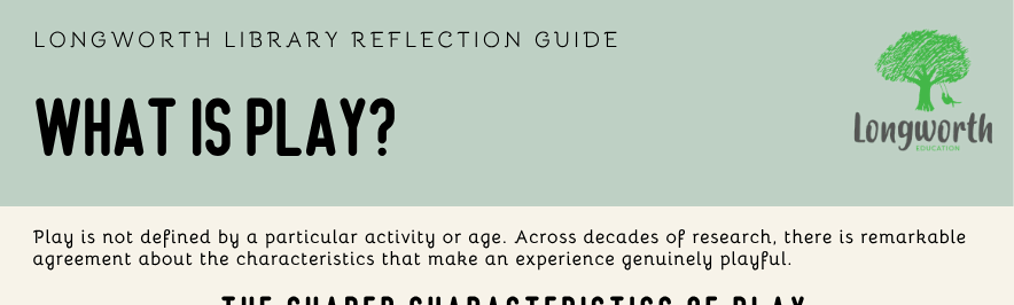
Ready to go deeper?
The Foundations of Play series is designed to introduce the key ideas that underpin high-quality play pedagogy. If you're ready to move beyond the foundations, Longworth Education offers practical professional learning that helps turn these ideas into confident classroom practice.
Whether you're an individual teacher looking to deepen your understanding, a leadership team supporting school-wide change or a school seeking ongoing coaching, we're here to help.
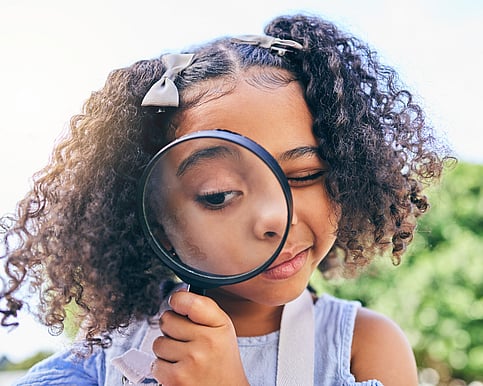
Keep LearningContinue exploring free articles, practical guides and resources to strengthen your understanding of play pedagogy.
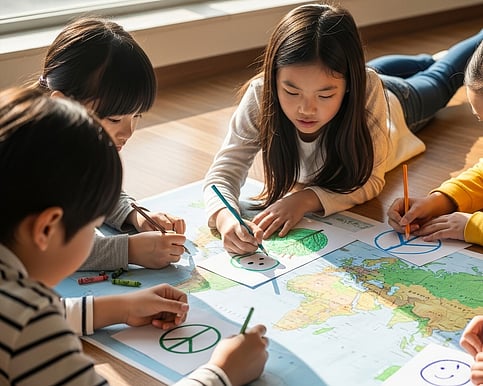
Learn With UsJoin one of our webinars, online courses or workshops to build your confidence and deepen your practice.
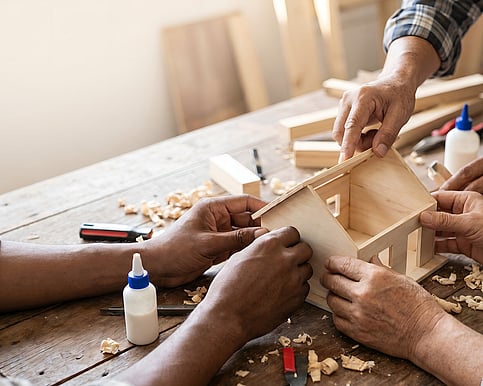
Partner With UsLooking for school-wide change? Discover our coaching, professional learning and leadership support.