Why Play Matters
Understanding why play remains one of the most powerful contexts for learning at every age
The debate about play is often framed as an argument about age. We hear that young children need play before they are ready for "real learning", or that play is appropriate in the early years but should gradually give way to more formal instruction as children grow older.
The research tells a different story.
While the nature of play changes across childhood, the processes that make play such a powerful context for learning do not disappear when children turn five, eight or twelve. Curiosity, experimentation, collaboration, imagination, problem solving and the freedom to test ideas continue to shape learning throughout our lives.
The question is not whether older children still benefit from play.
It is why play matters and whether schools continue to create opportunities for playful learning as children grow.
Play is far more than knowledge
One of the greatest strengths of play is that it rarely develops just one thing at a time.
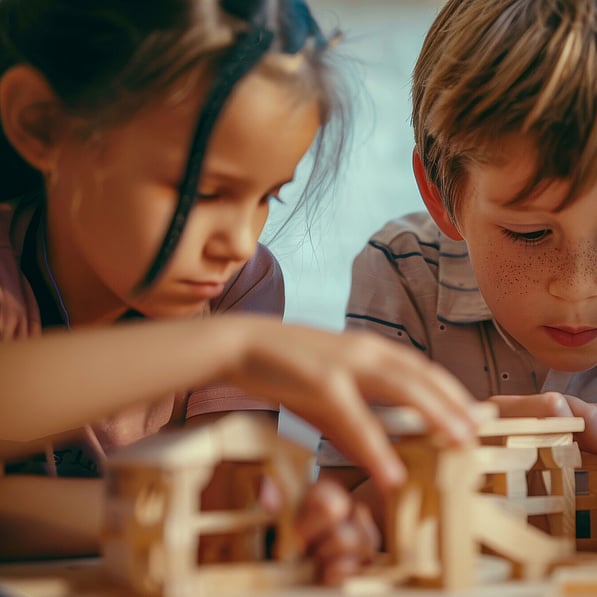
A child building a fort is not simply learning about construction. They are negotiating roles, planning ahead, solving problems, communicating ideas, adapting when plans fail and regulating frustration. These cognitive, social and emotional processes happen simultaneously because real learning is rarely separated into curriculum boxes.
This is one of the reasons play transfers so readily across learning areas. Rather than practising isolated skills, children are learning how to think.
Play strengthens the brain's executive functions
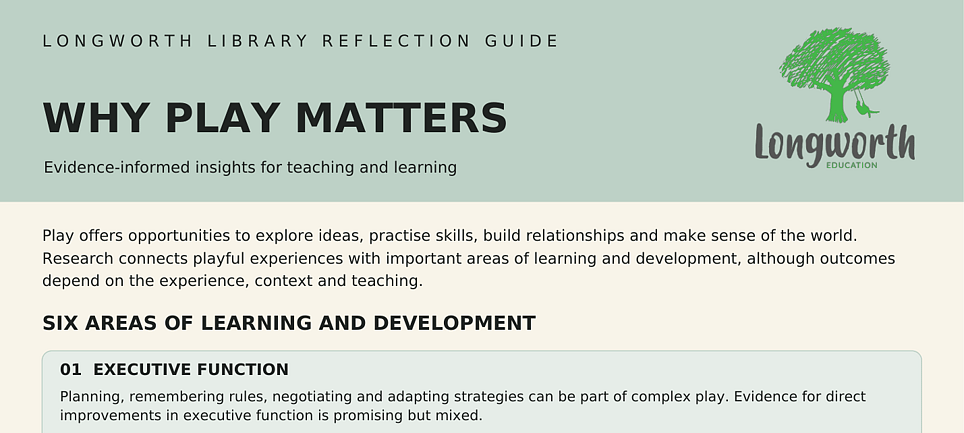
One of the strongest contemporary research findings is the relationship between play and executive function.
When children plan, remember rules, shift strategies, inhibit impulses, monitor their own thinking and adapt to unexpected challenges, they are strengthening the very capabilities that underpin success across literacy, mathematics, science and everyday life.
These skills cannot simply be explained to children. They develop through repeated opportunities to use them in meaningful situations.
Play provides exactly those opportunities and why play matters most.
Play supports literacy and mathematics - it doesn't compete with them.
Perhaps the greatest misconception surrounding play is that it replaces academic learning.
High-quality play pedagogy does the opposite.
Children read because they need information. They write because they have something worth communicating. They measure, estimate, classify, count and calculate because those skills help solve problems they genuinely care about.
Play creates meaningful reasons to use literacy and mathematics rather than asking children to practise them in isolation.
The goal is not choosing between play and academic learning.
It is recognising that powerful learning often occurs when the two work together.
Play remains important long after the early years
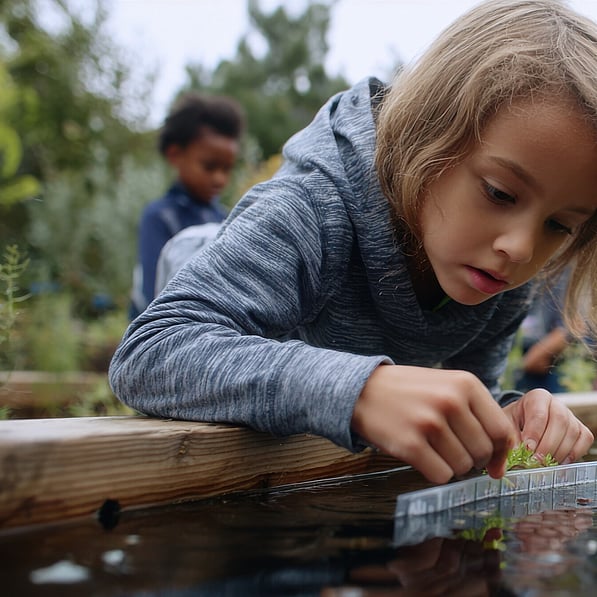
As children grow older, play changes in form, but not necessarily in purpose. Fantasy may become debate, construction may develop into design, and collecting may lead to research, categorisation and the pursuit of specialist knowledge. Physical exploration can evolve into sport, performance or outdoor challenge, while imaginative ideas may take shape through enterprise, invention or collaborative projects.
The activities look different, but the underlying processes remain remarkably consistent. Children and adults alike continue to learn by experimenting, imagining possibilities, testing ideas, taking risks and adapting when things do not work as expected. Scientists experiment, engineers prototype, artists sketch and researchers follow questions without knowing exactly where they will lead. We may not always describe these activities as play, yet they rely on many of the same qualities that make play such a powerful context for learning.
Play is not something children simply grow out of. More often, it is something education gradually stops recognising.
What does this mean for practice?
If play matters across childhood, then our role is not simply to protect time for play in the early years.
It is to design learning that preserves the qualities of play—agency, curiosity, experimentation, collaboration and meaning—even as curriculum expectations become more sophisticated.
The challenge is not to make every lesson into a game.
The challenge is to ask:
How can we create learning experiences that retain the characteristics of play while deepening children's thinking?
Pause and Reflect
Which characteristics of play remain visible in your setting as children grow older?
Where do literacy and mathematics emerge naturally through authentic purposes?
What opportunities do children have to plan, collaborate, experiment and adapt?
As children move through your school, does play evolve, or gradually disappear?

Longworth Practice Guide
Ready to Go Deeper
The Foundations of Play series is designed to introduce the key ideas that underpin high-quality play pedagogy. If you're ready to move beyond the foundations, Longworth Education offers practical professional learning that helps turn these ideas into confident classroom practice.
Whether you're an individual teacher looking to deepen your understanding, a leadership team supporting school-wide change or a school seeking ongoing coaching, we're here to help.