The Science of Play
How playful experiences help build flexible, capable brains
The human brain is not simply built and then filled with knowledge. It develops through experience.
Each time children move, investigate, communicate, imagine, practise, make a mistake or solve a problem, their brains are responding to what they encounter. Neural pathways that are repeatedly activated become more efficient, while new experiences invite the brain to form and reorganise connections. This capacity to change in response to experience is known as neuroplasticity, and it continues throughout childhood, adolescence and adulthood.
Play is particularly powerful because it rarely asks the brain to do only one thing at a time. A playful experience may involve movement, language, memory, emotion, decision-making, sensory information and social interaction, often all within the same few minutes. Rather than exercising one isolated skill, play recruits multiple systems and asks them to work together.
Play does not simply occupy the brain. It organises, challenges and strengthens it. And the science of play tells us why.
The brain grows through active experience
Children’s brains are not passive recipients of information. They develop through active engagement with people, places, materials and ideas.
During play, children predict what might happen, test those predictions and adjust their actions in response to what they discover. A tower collapses, so its design changes. A game stops working, so the rules are renegotiated. A dramatic storyline becomes more complicated, requiring children to remember roles, interpret one another’s intentions and respond to unexpected turns.
These cycles of action, feedback and adjustment matter because learning changes the brain. When children encounter a manageable challenge and remain engaged long enough to work through it, they are doing more than reaching an answer. They are building increasingly efficient ways of paying attention, processing information and responding to new situations.
The value lies not only in what children produce, but in the mental work required to get there.
Play exercises the brain's executive functions
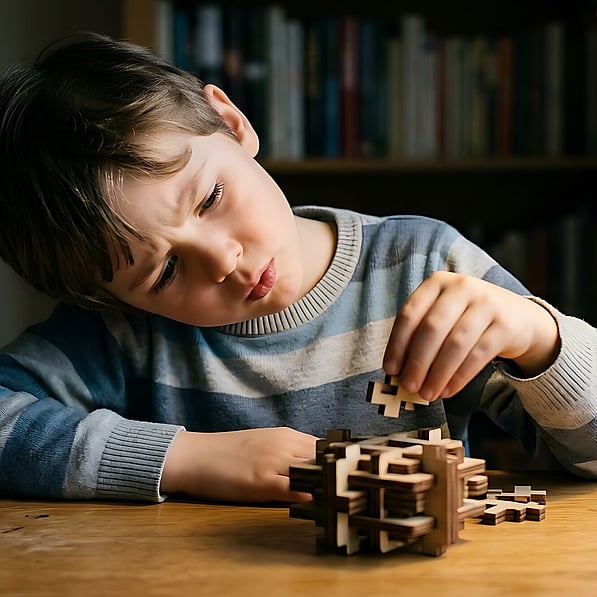
Some of the most important capabilities supported through play are known collectively as executive functions. These include working memory, inhibitory control and cognitive flexibility.
Working memory allows children to hold information in mind and use it. Inhibitory control helps them pause, manage an impulse or resist an immediate response. Cognitive flexibility enables them to change perspective, shift strategy and adapt when circumstances change. Together, these capabilities help children plan, sustain attention, regulate their behaviour and work towards a goal.
Play gives children frequent and meaningful reasons to exercise them. Games require players to remember rules and control their responses. Construction requires planning, sequencing and revision. Dramatic play asks children to hold a role in mind while responding to the ideas of others. Collaborative investigations require them to negotiate, reconsider and adapt.
These skills remain important well beyond the early years. Older children draw upon the same executive processes when designing, strategising, debating, creating, researching and solving complex problems. The play may become more sophisticated, but the brain is still being asked to plan, persist, monitor and adjust.
Executive function cannot be developed through explanation alone. Children need repeated opportunities to use it.
Play provides the practice field.
Movement is part of thinking.
The science of play demonstrates that the brain does not develop separately from the body.
Active play brings together sensory information, balance, spatial awareness, coordination, timing and decision-making. When children climb, chase, balance, build, dance or navigate a changing environment, their brains continually integrate information from their bodies and surroundings in order to plan what to do next.
Physical activity is associated with benefits for attention, executive function and cognitive performance across childhood and adolescence. Importantly, active play is not simply exercise disguised as a break from learning. Movement itself can involve anticipation, judgement, memory, creativity and rapid problem-solving.
A child crossing a makeshift obstacle course is not only developing strength and coordination. They are judging distance, managing risk, adapting their movements and learning how their body operates in space.
Movement is not an interruption to thinking. It is one of the ways thinking develops.

Emotion and connection shape the learning brain
Brains learn best when children feel secure enough to explore, but interested enough to remain engaged.
Play often creates this balance. It offers uncertainty without necessarily creating threat, challenge with some sense of control, and opportunities to take risks within relationships and environments that feel safe. Enjoyment and personal meaning help sustain attention, while manageable difficulty encourages persistence.
Social play adds another layer of complexity. Children must read facial expressions, interpret tone, anticipate other people’s actions and coordinate their own responses. They practise dealing with disagreement, disappointment and unpredictability while remaining part of a shared experience.
Responsive relationships also help regulate stress, making it easier for children to access the attention, memory and self-regulation required for learning. Play with trusted peers and adults can therefore support cognitive, social and emotional processes at the same time.
This does not mean all play must be happy, calm or harmonious. Play may contain frustration, conflict, uncertainty and failure. What matters is that children have enough safety, agency and support to remain engaged and find a way forward.
What does this mean for practice?
If play matters across childhood, then our role is not simply to protect time for play in the early years.
It is to design learning that preserves the qualities of play—agency, curiosity, experimentation, collaboration and meaning—even as curriculum expectations become more sophisticated.
The challenge is not to make every lesson into a game.
The challenge is to ask:
How can we create learning experiences that retain the characteristics of play while deepening children's thinking?
Play builds adaptable brains
Much classroom learning is designed around reaching a known answer. Play frequently begins without one.
Children may have an intention, but they cannot fully predict what will happen. Materials behave unexpectedly. Other people introduce different ideas. Plans fail. New possibilities emerge. The learner must respond to information that was not available at the beginning.
This uncertainty is not a weakness of play. It is part of its cognitive value.
The brain must remain flexible, draw upon previous experience and generate new responses. Over time, children are not only accumulating knowledge; they are developing the capacity to use what they know when circumstances change.
That capacity matters at every age. The worlds children will enter cannot be navigated through recall alone. They will need to think across disciplines, tolerate uncertainty, revise their ideas and approach unfamiliar problems with curiosity rather than fear.
Play gives the developing brain somewhere to rehearse that work.
What does this mean for teachers?
The science of play does not suggest that every moment should be unstructured or that explicit teaching has no place. Nor does it mean that adding a playful activity automatically transforms learning.
The deeper message is that brains develop through what they are repeatedly asked to do.
When children spend time making decisions, sustaining attention, coordinating movement, managing emotion, testing ideas and responding to others, those capabilities are being exercised. When adults control every decision, remove every uncertainty and determine every pathway, children have fewer opportunities to do that cognitive work for themselves.
The question is therefore not simply:
What are children learning?
It is also:
What is this experience asking their brains to do?
That question helps us look beyond whether an activity appears busy, enjoyable or academically productive. It draws our attention to the thinking beneath it—and to the conditions that help flexible, capable brains develop.
Pause and reflect
What kinds of mental work are children doing during play in your setting?
Where are they required to remember, plan, inhibit, adapt or reconsider?
How often do children encounter challenges whose solutions have not already been determined?
As children grow older, do opportunities for complex playful thinking expand or diminish?

Longworth Practice Guide
Ready to go deeper?
The Foundations of Play series is designed to introduce the key ideas that underpin high-quality play pedagogy. If you're ready to move beyond the foundations, Longworth Education offers practical professional learning that helps turn these ideas into confident classroom practice.
Whether you're an individual teacher looking to deepen your understanding, a leadership team supporting school-wide change or a school seeking ongoing coaching, we're here to help.